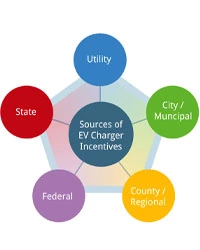
Rebates and incentives continue to play a major role in getting more EV charging stations installed across North America.
The EV charging market has come a long way over the past few years. Charging sessions are increasing, utilization is improving, and more businesses recognize that EV charging can be a valuable amenity, customer service, or revenue opportunity. Residential adoption has also grown as more drivers realize the convenience of having a Level 2 charger at home instead of relying on public charging.
But even as the market matures, the economics of EV charging are still challenging. For commercial installations, equipment, electrical upgrades, installation labor, permitting, networking, and ongoing operating costs can add up quickly. For residential customers, home charging can be a major factor in the decision to purchase an EV, but the added cost of equipment and installation can create another hurdle.
That is why rebates and incentives remain so important. They help close the gap between interest and action. A strong incentive can make a home charger feel more attainable, help a business move forward with a project, or make it possible to install more charging ports than originally planned.

EV Charger Incentives Are Still Strong
According to BriteSwitch’s RebatePro for EV Chargers, a record 85% of the US is currently covered by rebates, incentives, grants, or tax credits for installing EV charging equipment. That is the highest level of coverage we have seen since we started measuring EV charger rebate availability in 2021.
The dollar amounts remain significant, too. For Level 2 residential chargers installed for personal use, the average rebate across North America is currently $600. On the commercial side, the average rebate for Level 2 chargers is $2,560, while the average incentive for Level 3/DC fast charging stations reaches $27,014, but can be much higher with available make-ready incentives.
| Average EV Charger Rebate in North America |
|
|---|---|
| Level 2 Charger Residential |
$600 per charger |
| Level 2 Charger Commercial |
$2,560 per charger |
| Level 3 / DCFC Charger Commercial |
$27,014 per charger |
That level of support can make a big difference in whether a project moves forward. But there is a catch.
Finding a rebate is only the first step. Qualifying for it is another matter entirely. Many programs come with detailed requirements around location, customer type, charger use, networking, installation timing, and documentation. One of the most important, and often most frustrating, requirements is whether the charger itself appears on an Approved Product List.
The Approved Product List Dilemma
While the promise of rebates is enticing, the process to get these funds is not as straightforward as it should be. One pain point is the use of Approved Product Lists (APLs), which adds another layer of complexity to an already complicated process.
According to RebatePro for EV Chargers, 24% of incentive programs across North America currently have an APL. That percentage is similar across residential and commercial rebates, Level 2 and Level 3 (DCFC). The number of programs with their own approved lists has remained relatively consistent since we first started monitoring EVSE incentives in 2021.
That share might seem modest compared to other technologies. For instance, around 80% of commercial lighting rebates require that a fixture be on a standardized list, such as the DesignLights Consortium (DLC). So while approved list requirements are still a relative minority for EV chargers, many major metropolitan areas have Approved Product Lists, and overlooking them could significantly impact projects in those regions.

For example, some of the largest EV charger incentive programs in New York State, including Charge Ready NY 2.0 and programs funded by the Joint Utilities of New York, maintain APLs. If a charger is not listed by the applicable program, it may not qualify for valuable incentives in an important EV charging market.
In addition, 12% of the commercial programs have an Approved Network List (ANL). These lists do not necessarily focus on the charger itself. Instead, they specify which network the charger must be connected to.
Why Not Just Use the ENERGY STAR List?
ENERGY STAR has a specification for EVSE and maintains a list of hundreds of certified chargers. The ENERGY STAR specification sets requirements for certain measures, a key one being standby power. According to ENERGY STAR, EV chargers are typically in standby mode, meaning they are not actively charging a vehicle, for about 85% of the time. ENERGY STAR-certified EV chargers use 40% less energy in standby mode, reducing their impact on the environment.
So why don't rebate programs just use the ENERGY STAR list?

In some cases, they do. 12% of programs require ENERGY STAR certification in order to qualify for a rebate. Some programs use ENERGY STAR as a starting point, then narrow that list down to their own approved products.
But standby power consumption is not the only concern for rebate programs. For many EV charging programs, communication and reporting capabilities are just as important, if not more important. Some utilities may offer time-of-use or special EV charging rates, while others have a demand-response component that dials back charging during power events. For those initiatives, two-way communication with the charger is essential.
Approved Product Lists Are a Hassle for Everyone
While the use of APLs creates a challenge for nearly everyone in the EV charging space, each player has different pain points with these lists.
EV Charger Manufacturers / OEMs
For EV charger manufacturers, the first challenge is identifying which programs have an approved charger list. That alone can be a pain, requiring manufacturers to sift through pages of applications, program manuals, and technical guidelines. Once they find which programs have an APL, they need to figure out how to get on the list by contacting the program. Many programs don't have direct contact information; instead, they provide a generic email address for inquiries. In addition, the guidelines for chargers are often not published on the website, and even once a charger is approved, lists can take months to be updated.
Top 10 Brands on Approved Lists

EV Charger Rebate Programs
It's not easy for rebate programs either, as the sheer number of manufacturers and chargers available is daunting. The approved charger list for the Joint Utilities of New York, which covers most major utilities in the state, lists 66 companies and 465 chargers. In fact, across all approved lists in North America, over 100 companies are listed. That’s a lot to keep track of, and staff at these programs must constantly review chargers and update their approved lists.
Electrical Distributors / Installers
APLs also create problems for distributors and installers selling EV chargers. Since customers rely on them to provide useful product information, they must make sure the specific models they're offering are listed on applicable APLs. Also, they don't want to stock chargers that aren't eligible with the local rebate programs, or they end up with inventory they can't move.
Facility Owners
For a facility owner looking to install an EV charger, an approved list complicates an already complex rebate process. Sometimes, it is not just a matter of choosing an approved charger or an approved network. It may require both, leaving someone unfamiliar with EV charging to struggle to find a rebate-eligible solution.

Look at the above excerpt from Atlantic City Electric's guideline for their EV Charger program. The guideline lists eligible options first by network and then by charger, and a charger can be included under multiple networks. While that might make sense to someone in the EVSE industry, a restaurant owner looking to install a charger on their property will likely struggle with this cumbersome requirement.
Standardization Is Starting, but Very Slowly
In an ideal world, rebate programs would use a shared eligibility framework. Chargers that meet a consistent set of technical standards would qualify across programs, and manufacturers would not need to navigate dozens of separate approval processes. That may happen eventually, but not yet.
The EPRI Vetted Product List is one attempt to create a more standardized approach by evaluating EVSE equipment against a common set of criteria. While a few new rebate programs began using the EPRI list this year, it represents only a small share of the nearly 500 rebate programs available in North America.
EVCAN has also emerged as a managed charging specification intended to help simplify eligibility for chargers with managed charging capabilities.
These are positive developments. They show that the industry is moving toward more consistent qualification standards. But for now, these efforts only cover part of the market. Generally speaking, most EV charger rebate programs still operate with their own rules, forms, eligibility requirements, and documentation.
You Can’t Afford to Ignore Approved Lists
EV charger incentives remain a major opportunity, but finding all the programs that may apply is just the start. The devil is in the details; Approved Product Lists are one of the clearest examples of how rebate eligibility can become complicated quickly.
For manufacturers, distributors, installers, and facility owners, overlooking an APL can put the entire incentive at risk. A project can be in the right location, serve the right customer type, and appear to qualify for a strong rebate, but still run into trouble if the charger or network is not approved.
With average incentives still reaching hundreds, thousands, or even tens of thousands of dollars depending on the project type, approved lists cannot be treated as an afterthought. They should be a key part of the EV charger strategy discussion from the very beginning.
Find Rebates for EV Chargers
Before starting an EV charger project, check which rebates and incentives are available in your area.